
Dairy Alchemy: Transforming By-Products into Gold
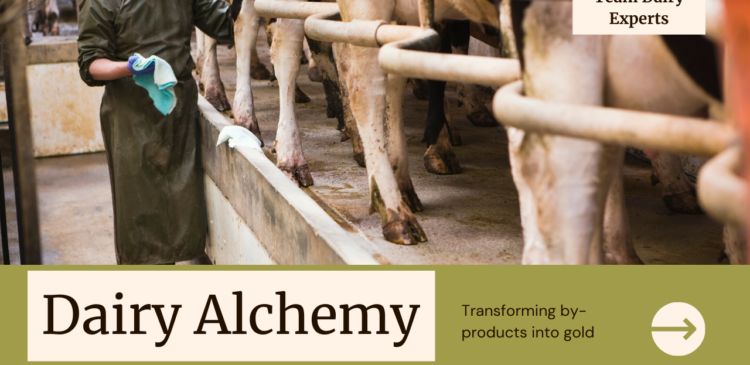
For centuries, dairy production has been at the heart of agriculture, providing nutrition in the form of milk. The dairy industry also produces co-products that can have economic, environmental and nutritional value. This article explores those opportunities while distinguishing farm by-products from processing streams.
Beyond the Milk Pail
Dairy businesses face challenges in waste management and resource use. Milk-processing operations generate streams such as whey and sweet-cream buttermilk. Further processing can produce ingredients such as whey protein and lactose. Manure, in contrast, arises on the farm. These materials need different collection, treatment and quality controls.
Liquid Gold: Whey’s Versatility Unveiled
Whey is the liquid separated from curd in cheese or casein manufacture. Its composition and recovery depend on the process. Before planning a recovery project, quantify the volume, solids, acidity, microbiological quality and seasonal availability rather than assuming one universal yield.
Whey Protein Prowess
Whey proteins can be recovered and concentrated for food and nutrition applications. The target ingredient specification, process hygiene and customer acceptance requirements should drive the recovery and drying design.
Lactose: More Than a Sweetener
Lactose has food and pharmaceutical applications. Producing a particular grade requires its own purification, quality and customer qualification requirements; a recovered dairy stream is not automatically pharmaceutical grade.
Buttermilk’s Uses
Sweet-cream buttermilk from butter manufacture can be evaluated for food-ingredient applications. Distinguish it from cultured drinking buttermilk: composition, treatment and specifications are not interchangeable.
Casein and Whey: Understanding the Separation
In ordinary cheese making, much of the casein is retained in the cheese curd while whey is separated. Commercial casein ingredients are commonly made from skim milk by acid precipitation or rennet coagulation followed by washing and further processing. Casein is therefore not simply an additional waste stream obtained alongside finished cheese. See Tetra Pak’s explanation of casein and caseinates.
Casein’s Diverse Portfolio
Casein and caseinates are used in food and other industrial applications. Identify the intended grade and end use before selecting raw material and processing technology. See Tetra Pak’s milk and whey ingredient guidance.
Lactose and Lactulose
Lactose and its derivative lactulose are different products. Manufacturing and marketing either for a regulated application requires a specific process, quality specification and compliance review.
Manure: A Farm By-Product
Dairy farms produce manure that can be managed as a nutrient resource. Storage, treatment and application must be planned to avoid pollution and unsafe handling.
Fertilizer Potential
Manure can contribute nutrients to crop production. Its value depends on the nutrient content, treatment, soil requirements and application practices; its use does not automatically eliminate environmental impacts.
Biogas Potential
Anaerobic digestion can convert suitable manure streams into biogas. Evaluate gas production, utilisation, leakage control, digestate management and economics together rather than counting all produced gas as usable energy.
Environmental Benefits Require Good Management
Recovering useful dairy streams can reduce avoidable waste, but collection, processing and drying also consume resources. Assess the full material, water and energy balances and the remaining effluent load.
Economic Considerations
Co-product recovery requires investment, reliable feedstock and a buyer for the finished output. Compare expected selling value with collection, processing, utilities, drying, packing, testing and transport costs.
Quality Assurance
Define the product specification before choosing equipment. Food, pharmaceutical and technical applications have different qualification requirements. Traceability, hygiene and testing remain necessary even when the raw material is described as a by-product.
Market Development
Obtain customer specifications and assess purchase interest before committing to capacity. A technically recoverable material is not necessarily a commercially viable product.
Conclusion
Dairy co-products offer opportunities for value recovery, but they are not automatically ‘gold’. A viable project combines the right separation process, raw-material quality, utilities, product specification and dependable market. Start with a measured mass balance and a realistic business case.